
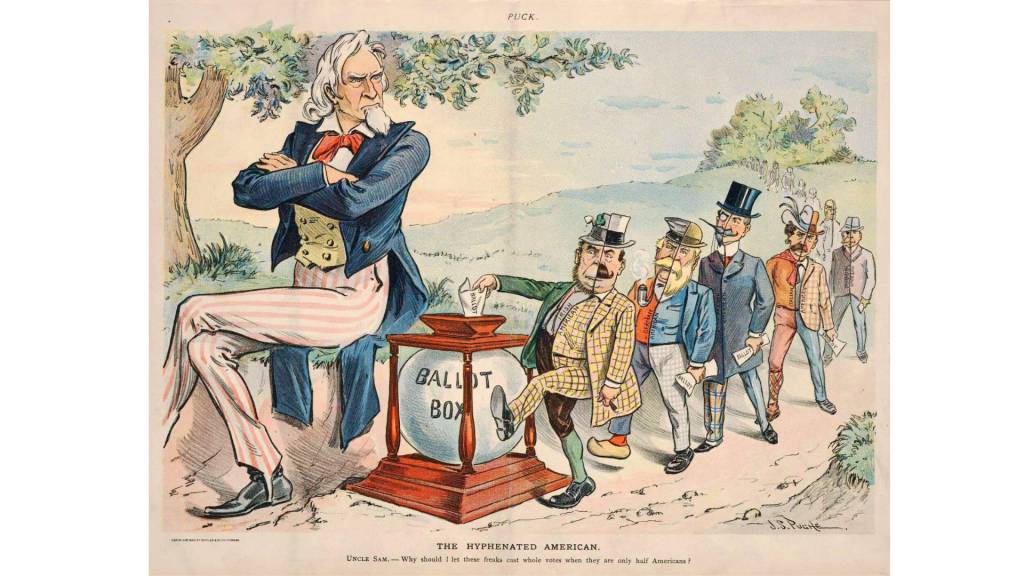
American cartoonist John S. Pughe published a political cartoon in Puck Magazine on August 9, 1899. This coincided with mass immigration to the United States from southern and eastern Europe. The image shows men submitting ballots, but each man is split down the middle between a typical American man for the time and their ancestral stereotypes. For example, an “Irish-American” is half a leprechaun. A disappointed Uncle Sam sits next to the ballot box, visibly annoyed. At the time, many ‘native’ Americans voiced concern for democracy, and that “hyphenated-Americans” would never be “true” Americans.
American identity has always been at the forefront of discussion concerning immigrant identities. Many prefer hyphenated titles, while others see themselves as one or the other.
In an interview with The New York Times, Mallika—the daughter of Indian immigrants—talked about her American identity. “I don’t like the term ‘Indian-American’… I don’t like the hyphenations, because I am American.”
Some see the hyphenated title as a divisive aspect of identity politics, getting caught up in the technicalities of ancestry rather than focusing on present issues. Others embrace the hyphen to stay connected to their familial cultures and help find community with people of similar backgrounds.
Shirleen Amiani, Senior Culture Writer and Editor at Just N Life, is a Kenyan immigrant who moved to the States at 12. Although not an American citizen, she feels immersed in American culture and spoke about how living in the US impacted her identity. “I think…in the context of living [in the United States] … I’ve become Americanized, especially when interacting with people back in my home country [Kenya], there’s a disconnect… Unless you’re really intentional about honing in on your roots and maintaining them, it’s so easy to lose your sense of culture and identity.”
Especially amid election season and America’s 250th ‘birthday’ this year, the discussion of voting Americans and where their priorities stand comes up regularly.
What it means to be an American varies depending on whom you ask. For hundreds of years, Americans who identify with hyphens have been treated as others. Today, many believe “hyphenated Americanism” doesn’t exist, and that people choose to live under these labels to gain sympathy.
“In this country, American means White. Everybody else has to hyphenate.”
Toni Morrison, The Guardian, January 29, 1992
Amiani highlighted that America is full of opportunities for everyone here, but systems ingrained in American culture and history are discriminatory against minorities—American citizens or not. “I think, specifically from the Black perspective, [American identity] looks different because your racial identity is the first marker that people view you…and that takes away some of the privilege that comes with American identity.”
In 2017, The New York Times released a multimedia project in collaboration with artist, photographer, and filmmaker Bayeté Ross Smith. Americans of all races, religions, and backgrounds recalled the times when they felt the most and least American.
Each American approaches their personal identity differently. Many may agree or disagree with a fellow American’s identity, but that’s not something so easily remedied.
What makes somebody American? A passport, birth certificate, or a reputation? It depends on whom you ask.
Amiani continues, “From the Black perspective [and] especially as an immigrant…something I came to realize is that even striving for American citizenship as a Black person is not enough to stop all the things that come with Blackness… even Black Americans in this country are treated like second-class citizens… given the history of how this country came to be…”
The Atlantic published What Makes an American? by French journalist Raoul de Roussy de Sales in March 1939—merely six months before Germany invaded Poland. Sales, who lived in New York City, brought the complexity of American identity to the forefront. De Sales posed a poignant question about American individualism and a culture shaped by a focus on the self. “The question is…how much longer can the American maintain the posture of a man who stands on [his] tiptoe[s] on the ground because he feels it is his destiny to keep his head above the clouds?”

This question has troubled the American mind for decades and will continue to do so for years to come.
“To begin with, it took me some time to formulate to myself an answer to the very simple question: ‘What makes an American? How does it feel to belong to this nation?’”
Raoul de Roussy de Sales, What Makes an American? The Atlantic, March 1939
This doesn’t negate the beauty of the United States’ multiculturalism blossoming into communities and subcultures that are so distinctly American. The label of America as a ‘melting pot’ is true in its most beautiful and raw form. Immigrants come, and their cultures mix with American life and other cultures to create unique practices and experiences.
Amiani continued, “I think [America] is such a beautiful melting pot too… the opportunity to come here and revamp yourself and be what you want to be here… I do appreciate that about America, that anything is possible…you can come from a completely different background, disenfranchised, and end up making it into some of the highest positions of power.”
Regardless of someone’s citizenship status in the United States, being an American can mean different things. You don’t need a passport with the Constitution’s preamble printed inside to prove you’re part of American life and culture. Sometimes it’s much simpler than that.
What's Your Reaction?